

sparc_logomore_option
SPARC
About SPARCLEAPS ProjectResourcesGet InvolvedGallery
research
research
research
research
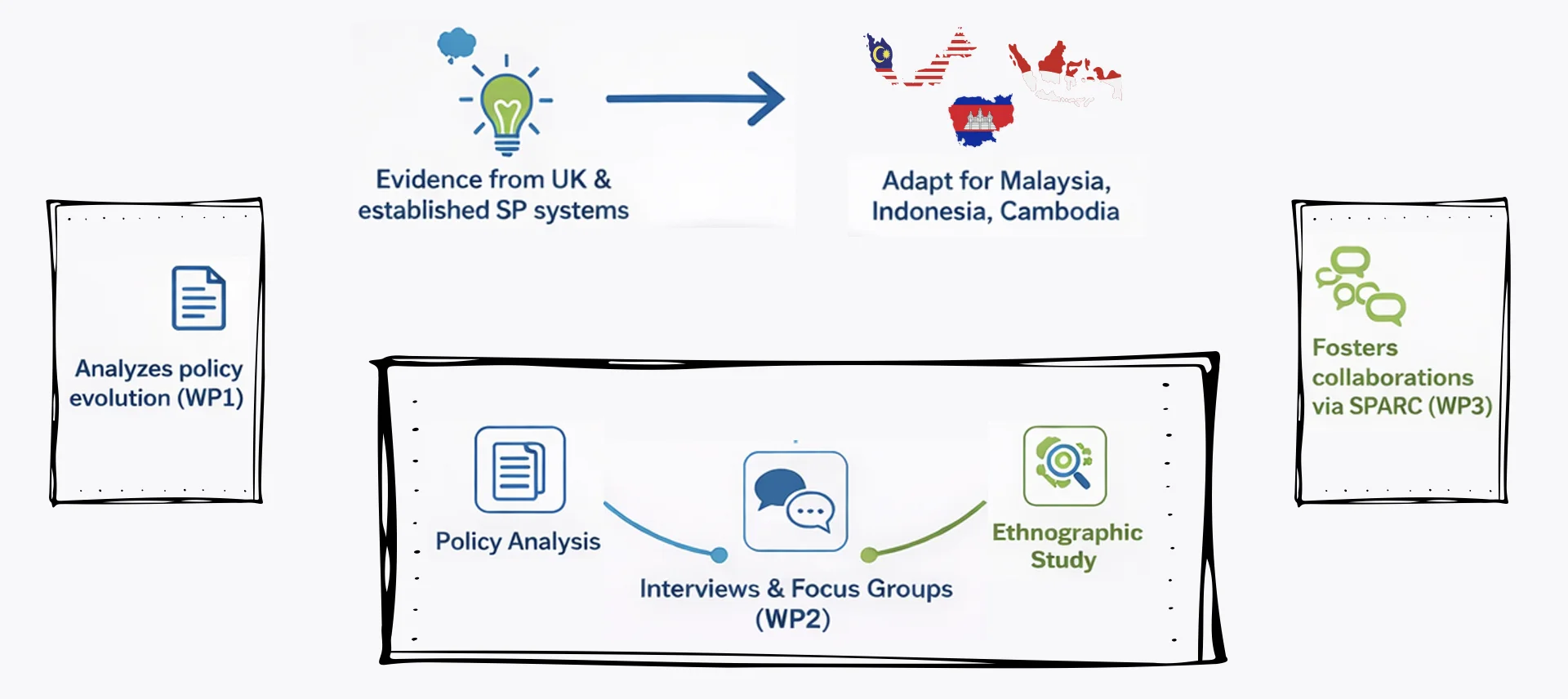
The LEAPS project is organised into three interconnected work packages
From evidence to actionLEAPS connects research, policy, and practice to build inclusive social prescribing systems across Southeast Asia.
evidenceUnderstanding evidence useHow is evidence used in policymaking around SP?What global models of evaluation and implementation exist?
adaptingAdapting SP for Southeast AsiaHow can UK/global evidence be made relevant to SEA contexts?What are the barriers, enablers, and cultural considerations?
communityCommunity of practiceBringing together researchers, practitioners, and policymakerTraining, toolkits, co-design workshops, and policy dialogues

research
research
The LEAPS project is organised into three interconnected work packages
From Evidence to ActionLEAPS connects research, policy, and practice to build inclusive social prescribing systems across Southeast Asia.
evidenceUnderstanding Evidence UseHow is evidence used in policymaking around SP?What global models of evaluation and implementation exist?
adaptingAdapting SP for Southeast AsiaHow can UK/global evidence be made relevant to SEA contexts?What are the barriers, enablers, and cultural considerations?
communityCommunity of PracticeBringing together researchers, practitioners, and policymakerTraining, toolkits, co-design workshops, and policy dialogues
About LEAPSLeveraging social prescribing evidence in policymaking: learning, application, and sustainability (LEAPS) is a multi-country research programme exploring how social prescribing can be localised and co-developed for use in Southeast Asian health systems and communities.
about leaps
We aim to understand
Policy & evidence
policy_evidence
Understanding global evidenceHow evidence has shaped SP policy in high-income countries
policy_evidence
Localisation & co-development
Adapting for local contextsHow that evidence can be adapted for Malaysia, Indonesia, and Cambodia
policy_evidence
Sustainability & inclusion
Building sustainable modelsHow to build sustainable, inclusive models of SP based on local strengths
What we've found so farThese insights are being refined as data collection continues:
Early Foundations(20062010)
Community prevention, wider determinants & "wellbeing prescriptions"
View more
Pre-Formalisation(20142017)
Building blocks of SP via new care models & voluntary-sector partnerships
View more
Formalisation(20182020)
SP becomes a national NHS service
View more
Expansion, Integration & Diversification(20202023)
SP as a multi-sector, multi-modal public health tool
View more
Cambodia
Guided by five national policies, the initiative focuses on community empowerment, NCD prevention, ageing, mental health, and primary care. Launched as a pilot in 2022 by RUPP researchers with WHO support, it targets older adults and mental health, with 2024–2025 evidence showing improvements in loneliness, access to services, and wellbeing
Indonesia
Guided by Indonesia’s Law No. 17 of 2023, the approach emphasises community empowerment and multi-sectoral collaboration, with grassroots initiatives and nationalprogrammes such as puskesmas, posyandu, and kader which are aligned around non clinical referrals, social connectedness, and holistic wellbeing
Malaysia
Guided by seven national policies, the approach prioritises active living, prevention of NCDs, cancer and mental health conditions, and elderly care, with informal alignmen
what we found principle
Join SPARC for healthier communities